
An early flight changes the whole shape of a trip. A 6 AM departure does not just mean an early alarm. It means a 3 AM wake-up if you are driving in from across town, a dark highway, a search for parking, and a race through security while half asleep. One delay on the way, and the trip starts with stress before you have even left the ground.
The simplest fix is to spend the night before at or near the airport. You trade a long, anxious morning for a short walk to the terminal, and you start your trip rested instead of rushed. This guide covers what to check before booking an early-flight hotel, using the in-terminal Tampa Airport Marriott at Tampa International Airport (TPA) as the example.
Why the Night Before Matters More Than the Flight
Most travelers plan their flight carefully and their morning barely at all. That is backwards. The morning of an early flight is where things go wrong: traffic that was clear the day before, a parking shuttle that takes longer than expected, a longer-than-usual security line, or a terminal that is further from the entrance than you remembered.
Staying near the airport removes most of those variables. Instead of building in an hour or more of driving and parking, you build in a walk of a few minutes. Instead of waking at 3 AM, you might wake at 4:30 or 5. That extra sleep is not a luxury on a travel day. It is the difference between arriving at your destination functional and arriving exhausted.
There is also a cost angle that people miss. A pre-dawn taxi or ride service to the airport can be expensive, especially with surge pricing in the early hours, and airport parking for several days adds up too. A night at an airport hotel is not free, but once you subtract the ride or the parking, the gap is often smaller than it looks. Compare the full picture, not just the room rate.
The In-Terminal Option: Tampa Airport Marriott
The strongest version of the airport-night idea is a hotel connected directly to the terminal, and Tampa has one. The Tampa Airport Marriott sits at 4200 George J. Bean Parkway, directly connected to Tampa International Airport, roughly a tenth of a mile from the airport reference point, with a direct indoor terminal connection. Guests walk between the hotel and the terminal without going outside, without a shuttle, and without a car.
That matters most on an early morning. There is no waiting for a bus in the dark, no wondering whether the shuttle has started running yet, and no extra transfer to miss. A shuttle is listed as complimentary, but for most guests it is simply unnecessary, since the walk indoors covers it.
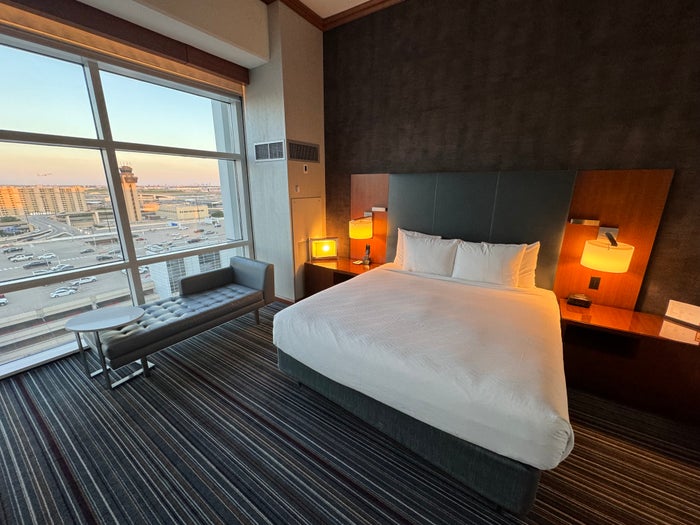
The hotel itself is a 4-star, full-service property with around 298 guestrooms and suites. The rooms have been renovated, with soundproof windows, comfortable bedding, smart televisions, mini-refrigerators, work desks, and seating areas. Soundproofing deserves a special mention here: an in-terminal hotel sits inside the airport environment, so windows that block terminal noise are what make the room sleepable rather than just convenient. Guest feedback consistently praises the soundproof rooms and the convenience of collecting luggage and walking straight to the hotel.
Beyond the rooms, the hotel has several restaurants, an outdoor swimming pool, a fitness center, a Club Lounge for eligible guests, day-use rooms, luggage storage, and extensive meeting space. Standard rooms run from king rooms for one or two travelers to two-queen rooms of around 400 square feet for families, with larger 500-square-foot rooms and suites above that, including an Executive Suite of around 654 square feet. Check-in is from 3 PM and check-out is by noon, the property is non-smoking, and the minimum check-in age is 18, which is worth noting for younger travelers.
In-Terminal vs. Off-Airport: What Changes
An in-terminal hotel is not the only way to handle an early flight. Hotels a short drive from the airport can work well too, usually at a lower nightly rate. The question is what you are trading for that saving. This comparison lays it out.
|
|
In-terminal hotel (example: Tampa Airport Marriott) |
Off-airport hotel nearby |
|---|---|---|
|
Distance to terminal |
Direct indoor connection, about 0.1 mile |
A short drive away, typically a few miles |
|
Transport to terminal |
Walk indoors, no shuttle needed |
Shuttle, taxi, ride service, or your own car |
|
Wake-up time for a 6 AM flight |
Later, since the terminal is steps away |
Earlier, to allow for transfer and waiting |
|
Risk of a missed transfer |
Very low, nothing to catch |
Low but real, if a shuttle is delayed or full |
|
Parking |
Paid self-parking and valet on site |
Usually free or cheaper parking |
|
Nightly rate tendency |
Typically higher, you pay for the location |
Typically lower for a similar room |
|
Breakfast before an early flight |
Restaurants on site, but breakfast is generally not included in standard rates, so check hours and cost |
Varies, some include breakfast, hours may not suit very early departures |
|
Noise |
Soundproof windows are important, and this hotel has them |
Usually quieter surroundings, further from terminal activity |
|
Best for |
Very early flights, tight connections, late arrivals, travelers with lots of luggage |
Travelers with a car, flexible mornings, or a tighter budget |
The table makes the trade-off clear. An in-terminal hotel costs more, but it buys you sleep, certainty, and a walk instead of a transfer. An off-airport hotel saves money, but it costs you an earlier alarm and a transfer you have to time correctly. For a 5 or 6 AM flight, most travelers find the in-terminal option worth it. For a 9 AM flight, the off-airport saving starts to look more attractive.
What to Check Before Booking for an Early Flight
Whatever hotel you choose, these are the details that matter specifically for an early departure. Checking them takes a few minutes and prevents the most common early-flight problems.
Check-in time and arrival plans. Tampa Airport Marriott's check-in is from 3 PM, which suits an evening arrival the night before your flight. If you are arriving late at night, confirm that late check-in is available and that your reservation is held for a late arrival, so a delayed flight does not cost you the room.
Breakfast hours. This is the detail most people forget. If your flight leaves at 6 AM, you will likely leave the hotel before most restaurants open, and breakfast may not be included in a standard rate anyway. At Tampa Airport Marriott, breakfast is generally not included with standard rates, and Club Lounge access may cost extra depending on your reservation. Before you book, check what food is available at the hour you will actually leave, whether that is an early restaurant opening, a grab-and-go option, or a lounge. If nothing is open, plan to eat at the airport after security instead of assuming the hotel will feed you.
Wake-up calls and alarms. Do not rely on a single phone alarm for a 4 AM wake-up, especially if you are changing time zones or your phone is on silent from the night before. Set two alarms, and ask the hotel for a wake-up call as a backup. It costs nothing and it has saved more flights than any other hotel service.
Which terminal and gate area. Tampa International Airport's layout means your departure point may not be right next to the hotel entrance, even in an in-terminal hotel. Check which terminal and airside your flight leaves from before the morning, and allow time to get there. The walk from an in-terminal hotel is short, but it is not zero, and knowing the route the night before removes a morning of guesswork.
Security timing. Early mornings can be surprisingly busy at security, since many flights depart in the first bank of the day. Even from an in-terminal hotel, give yourself the airport's recommended arrival buffer rather than cutting it fine because the hotel is close. The hotel saves you the drive, not the security line.
Parking if you are driving. If you are leaving a car behind during your trip, compare the hotel's parking charges with the airport's own parking. Tampa Airport Marriott offers paid self-parking and valet, and the rates and rules for multi-day stays are worth confirming in advance, since parking can add a noticeable amount to a longer trip.
Day-use rooms for layovers. If your early flight is part of a longer journey with a daytime layover, ask about day-use rooms. Tampa Airport Marriott offers them, and a few hours in a real room with a shower and a bed can turn a long connection from an ordeal into a rest. Day-use availability varies, so confirm it before counting on it.
A Sample Timeline for a 6 AM Flight
It helps to see what an early-flight morning actually looks like from an in-terminal hotel, compared with driving in. The times below are a typical example, not a rule, and you should adjust them to your airline's advice and your own comfort level.
From an in-terminal hotel, a reasonable plan is: wake around 4 AM, be ready by 4:30, walk to the terminal, and be through security with time to spare before a 6 AM departure. You get a full night's sleep the evening before, a calm morning, and no driving in the dark.
Driving in from across town for the same flight often means: wake around 2:30 or 3 AM, leave by 3:30, drive, park, wait for a parking shuttle, and reach the terminal with the same security buffer. You lose roughly an hour of sleep and add three separate steps where something can go wrong.
That lost hour and those extra steps are what you are paying to avoid with an airport hotel. For a single early flight, the difference is comfort. For a traveler who flies early regularly, it is the difference between a sustainable routine and a miserable one.
Who Benefits Most from an Airport Hotel
An airport hotel night is not necessary for every trip, but some travelers benefit far more than others.
Families with young children benefit enormously, since an early drive with tired children, car seats, and luggage is stressful for everyone. A two-queen room near the terminal lets the family sleep properly and walk to the flight without a pre-dawn car journey.
Business travelers with early meetings benefit too, because they arrive at their destination rested and presentable rather than rumpled from a 3 AM start. A room with a proper desk and a good shower the night before is a small thing that shows up in the meeting the next day.
Travelers with tight connections or late arrivals benefit for the opposite reason: they arrive late, sleep in a real bed steps from the terminal, and catch an early onward flight without leaving the airport at all. Day-use rooms serve the same purpose for long daytime layovers.
And anyone with a lot of luggage, mobility needs, or anxiety about missing a flight benefits from removing the transfer entirely. The fewer moving parts in your morning, the fewer things can go wrong.
Booking Tips for Early-Flight Stays
A few booking habits make an early-flight stay work better. First, book a flexible rate if your flight times could change. The lowest rate for a room is usually the least flexible, and rebooking an airport hotel at short notice after a flight change can cost more than the flexible rate would have.
Second, confirm the room category, not just the hotel. A standard king room and a larger two-queen room are different stays, especially for a family, and the room you pictured when booking should be the room you get.
Third, compare the final total, not the headline rate. Parking, breakfast, lounge access, and taxes all change the real cost, and an in-terminal hotel's higher nightly rate can look different once you subtract a pre-dawn taxi fare or several days of airport parking.
Fourth, tell the hotel about your early departure when you book or check in. Staff can note your wake-up call, advise on the quickest route to your terminal, and confirm what food is available at your departure hour. For a 5 AM flight, that two-minute conversation is worth having.
Finally, check the newest guest reviews before you pay, particularly for noise and service. An airport hotel lives or dies on how well it sleeps, and recent reviews are the best guide to whether the soundproofing and the service are holding up.
Frequently Asked Questions
How early should I arrive at the airport for a 6 AM flight?
Follow your airline's advice, which is typically two hours before a domestic departure. Staying at an in-terminal hotel saves you the drive and the transfer, but it does not remove the security line, so keep the same arrival buffer you would otherwise use.
Is an in-terminal hotel worth the higher price?
For very early flights, most travelers say yes. You pay more for the room but you gain sleep, remove a transfer, and cut the risk of a morning delay. For later flights, an off-airport hotel at a lower rate often makes more sense.
Do I need a shuttle from Tampa Airport Marriott?
Normally no. The hotel is directly connected to the terminal by an indoor walkway, so you walk to your flight. A complimentary shuttle is listed, but for most guests it is unnecessary.
Can I get breakfast before a very early flight?
It depends on the hour you leave. Breakfast is generally not included in standard rates at this hotel, and restaurants may not be open at 4 or 5 AM. Check what is available at your departure hour when you book, and plan to eat at the airport after security if nothing is open.
What if my flight is delayed or I arrive late at night?
Confirm late check-in when you book so a delayed arrival does not cost you the room. If your flight is delayed into the next day, contact the hotel as early as you can to adjust the reservation.
Can I book a room just for a daytime layover?
Day-use rooms are offered at Tampa Airport Marriott, but availability varies. Ask in advance rather than assuming a room will be free when you arrive.
Is the hotel noisy because it is inside the airport?
The rooms have soundproof windows, and guest feedback generally praises how quiet they are despite the airport location. If you are a light sleeper, a higher-floor room can help, and recent reviews are the best check.
What is the minimum check-in age?
The minimum check-in age at Tampa Airport Marriott is 18. Younger travelers should confirm the policy before booking, since it can differ between hotels.
Final Word
Early flights punish poor planning more than any other kind of trip. The drive, the parking, the transfer, and the security line all stack up in the dark hours of the morning, and one delay can turn a routine departure into a missed flight.
Spending the night before at the airport removes most of that stack. An in-terminal hotel like Tampa Airport Marriott turns a 3 AM alarm and a dark drive into a short indoor walk, and that is a trade most travelers are glad to make for a very early flight.
Check the details that matter for your departure hour: breakfast availability, wake-up arrangements, parking, and your terminal route. Book a flexible rate if your plans could change, and compare the final total rather than the headline rate. Do that, and your early flight starts the way a trip should start: calm, rested, and on time.
